 Relax
in the Isle of Beauty
Relax
in the Isle of Beauty
Corsica is also named by French people "île de beauté" (the island of beauty) has an area of 8722 km2 of which more than 1,000 km of coastline (shared between gulfs, sandy and rocky beaches).
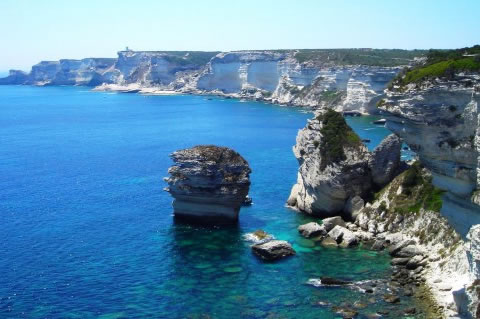
The west coast is the most indented because it is the most exposed to prevailing winds.
Many deep bays are present on this coast, with spectacular colorful landscapes and beautiful coves that offer at yachts an impressive selection of moorings.
The eastern shore is more linear: there are the long and stretch coastal of eastern plain, not unattractive with its beautiful beaches, especially in the south.
Corsica has preserved its exceptional natural spaces through an international marine park and nature reserves of Scandola at North West and Bonifacio in the southernmost in particular.
Cultural heritage has been preserved and each stop in a port or anchorage is also the opportunity to visit a picturesque village and historic monuments.
This is one of the largest island in the western Mediterranean after Sicily and Sardinia.
It is located 90 km from the Italian port of Piombino and 170 km northwest of Nice.
Sardinia is only 12 miles south of the island.
The climate of the island is the Mediterranean climate; Summer temperatures range from 25 to 30 degree Celsius
The winds that blow over in Corsica are libecciu, the sirocco and the north wind.
Corsica and its major attractions
- Scandola Reserve and the Creeks of Piana
- Bonifacio perched on cliffs and in front Lavezzi Islands
- The Similan Islands – one of the top ten diving sites in the world
- Ajaccio, a city steeped in history, to visit
- Calvi and Ile Rousse, Corsica two pearls
- Cap Corse, still wild and fascinating
The History
 The origin of the name Corsica is subject to much debate and remains a mystery. To the Ancient Greeks it was known as Kalliste, Corsis, Cyrnos, Cernealis, or Cirné. The latter Greek names are based on the Phoenician word for 'peninsula' (kir).
Corsica has been occupied continuously since the Mesolithic era. It acquired an indigenous population that was influential in the Mediterranean during its long prehistory.
After a brief occupation by the Carthaginians, colonization by the ancient Greeks, and an only slightly longer occupation by the Etruscans, it was incorporated by the Roman Republic at the end of the First Punic War and, with Sardinia, became a province of the Roman Empire.
In the 5th century, the Western half of the Roman Empire collapsed, and the island was invaded by the Vandals, the Ostrogoths, the Byzantines, the Lombards and the Saracens. Pepin the Short, king of the Franks and Charlemagne's father, expelled the invaders and granted Corsica to Pope Stephen II. This was the starting point of the temporal power of the Papacy.
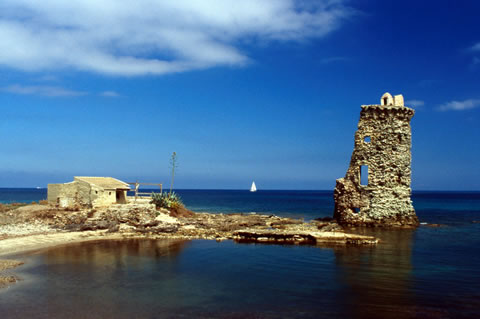
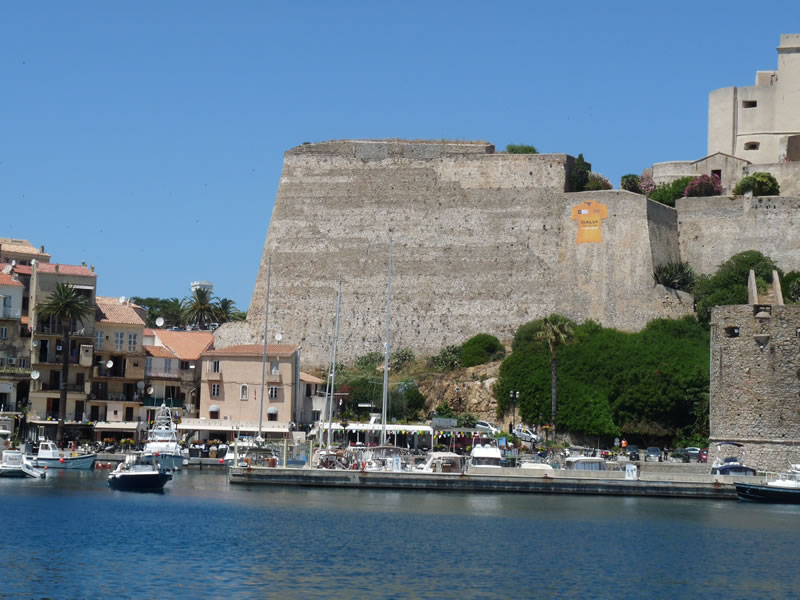
The Genoese had major political influence over Corsica from 1282 but formally annexed the island in 1347, and governed it until 1729 – interrupted only by a brief occupation by forces of a Franco-Ottoman alliance in the Invasion of Corsica (1553). The Barbary pirates from North Africa frequently attacked Corsica, resulting in many Genoese towers being erected
(see picture).
In 1729 the Corsican Revolution for independence began. After 26 years of struggle against the Republic of Genoa, the independent Corsican Republic was formed in 1755 under the leadership of Pasquale Paoli and remained sovereign until 1769 when it was conquered by France. The first Corsican Constitution was written in Italian (the language of culture in Corsica until the end of the 19th century) by Paoli. He proclaimed that Italian was the official language of Corsica.
The Corsican Republic was unable to eject the Genoese from the major coastal bodies. Following French losses in the Seven Years' War, Corsica was purchased by France from the Republic of Genoa in 1764. After an announcement and brief war in 1768–69 Corsican resistance was largely ended at the Battle of Ponte Novu. Despite triggering the Corsican Crisis in Britain, whose government gave secret aid, no foreign military support came for the Corsicans. Corsica was incorporated into France in 1770, marking the end of Corsican sovereignty. However, nationalist feelings still ran high.
Following the outbreak of the French Revolution in 1789, Pasquale Paoli was able to return to Corsica from exile in Britain. In 1794 he invited British forces under Lord Hood to intervene to free Corsica from French rule. Anglo-Corsican forces drove the French from the island and established an Anglo-Corsican Kingdom. Following Spain's entry into the war the British decided to withdraw from Corsica in 1796. Corsica then returned to French rule.
In 1814, near the end of the Napoleonic Wars, the island was briefly occupied again by British troops. The Treaty of Bastia gave the British crown sovereignty over the island, but it was later repudiated by Lord Castlereagh who insisted that the island should be returned to a restored French monarchy.
From Wikipedia
Gastronomy
 Food and Gastronomy in Corsica are a question of rhythm. The island is mixed of French and Italian culture. The relationship to the Earth is very important in this region of France, as is the Christian religion.
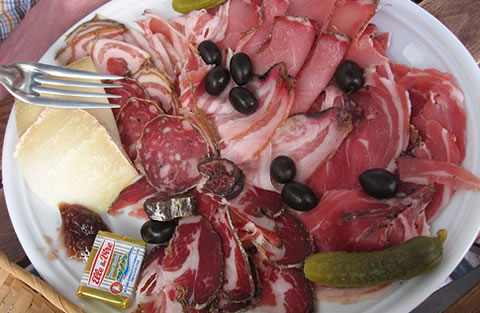
The Corsican honey will make you discover the richness of the insular flora. The Corsican vineyards such as Corsican Cape Muscatel, were appreciated as early as the highest antiquity and are classified today in AOC. From the black pigs, the Corsican producers draw a Pork-butchery with an inimitable taste. You will enjoy Prizuttu (raw ham), Salamu (a dry sausage), a thin slice of Coppa or even delicious Figatellu (liver sausage) which one enjoys in winter, roasted on wood fire. If the Corsican pork-butchery is excellent, the cheeses are also delicious, if you choose only one of them, treat yourself to Brin d'Amour, a delicious ewe cheese flavoured with sariette and rosemary...
Like many European countries, the best dishes in Corsica are those which are simple but delicious and descend directly from their peasant traditions. Soups embody the essence of the island, made with freshly caught local fish, legumes, peas, vegetables and chickpeas. Inspired by so many different nations over the centuries, Corsican cuisine is unlike anywhere else in the world. And blends dishes from foreign nations with their own local specialties to create a truly unforgettable gastronomic experience seeped in ancient traditions.
There are no less than 9 "AOC" (protected designation of origin) regions for wine in Corsica. Both quality reds and whites can be found with a large variety in strength and taste. This variety is brought both by the richness of Corsican vine soils, the altitude of the vines and the proximity of the sea. Corsican wines are also made unique by the use of grapes that are seldom used outside of the island; mainly Sciaccarellu, Niellucciu for red wines and Vermentinu for the whites.









 Email Us